The Multi-Carrier Shipping API Built to Scale
Connect once and reach 100+ carriers through a single integration—real-time rates, labels, tracking, and address verification, all from one API.
Connect once and reach 100+ carriers through a single integration—real-time rates, labels, tracking, and address verification, all from one API.

A shipping API is software that connects an application to multiple carriers through a single integration, so a team can compare rates, create labels, verify addresses, and track shipments in code. Instead of building and maintaining a separate connection for each carrier, one shipping API reaches 100+ carriers through one set of endpoints.
Ecommerce brands, 3PLs, and platforms use a shipping API to move carrier logic out of manual tools and into their own systems—so every label, rate check, and tracking update happens automatically at the moment an order is ready to ship.
You send a shipment’s details—origin, destination, dimensions, and weight—to the API. It returns real-time rates from every connected carrier, lets you buy and print the label you choose, and streams tracking events back to your system. The pattern is the same across carriers: rate, buy, track, through one REST interface.
The same three calls work whether you’re shipping USPS today and adding FedEx next quarter, so your integration doesn’t change as your carrier mix does.
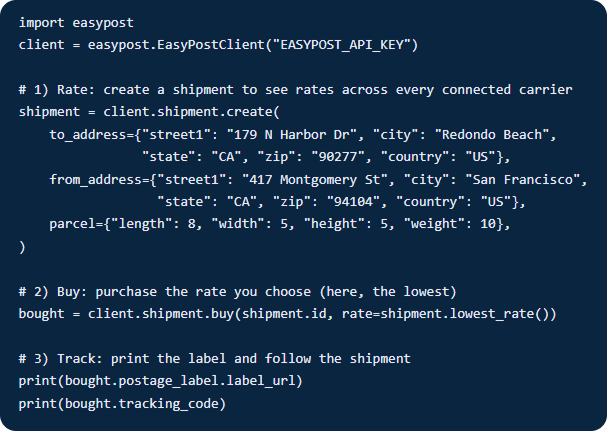

A shipping API integration is the connection between your store, OMS, or platform and a shipping API, so rate shopping, label creation, and tracking run automatically inside your own workflow. EasyPost integrates through client libraries for C#, Go, Java, Node.js, PHP, Python, and Ruby, plus prebuilt Ecommerce platform connections.
The alternative is integrating each carrier directly—separate contracts, credentials, and code to maintain as every carrier’s spec changes. One integration moves that maintenance off your team and lets you add carriers without new development work.
A shipping API handles the full label lifecycle in code: rate shopping across carriers, label creation, address verification before purchase, real-time tracking, insurance and claims, and automated carrier selection. The value isn’t any single feature—it’s running all of them from one integration instead of stitching vendors together.

The EasyPost API connects to 100+ carriers, including USPS, UPS, FedEx, and DHL, plus regional, same-day, cross-border, and
consolidator services. Adding a carrier doesn’t require new code—you connect once and turn carriers on as your mix changes.












The real advantage of a multi-carrier API isn’t fewer integrations—it’s the ability to make a different decision when conditions change. When a carrier has a service disruption, a zone gets expensive, or a deadline tightens, you can route around it at label time instead of renegotiating a contract. Direct integrations lock you into whatever you wired up.
The tradeoff is real: below a certain volume, managing multiple carriers adds overhead that can outweigh the rate savings, and the break-even point is different for every operation. The advantage grows with volume and with how often your shipping conditions change.
EasyPost is engineered for high-volume shipping, with 99.99% historic uptime maintained through consecutive peak seasons. Whether you generate hundreds of labels a month or thousands an hour, rate shopping, label creation, and tracking stay available when they matter most.
Client libraries support C#, Go, Java, Node.js, PHP, Python, and Ruby, so most teams integrate in the language they already build in.


Integrating the EasyPost API takes five steps: create a free account, get your API keys, install a client library for your language, create a shipment to return rates, then buy a label and track it. Most teams have a working rate-and-label call running in an afternoon.
Create an account, pull your API keys, and make your first rate call today. When you're ready to scale, our team can help you map carriers and workflows to your volume.
What is a shipping API?
A shipping API connects your application to multiple carriers through one integration to compare rates, create labels, verify addresses, and track shipments programmatically—reaching 100+ carriers without wiring up each one.
How much does a shipping API cost?
EasyPost is free to start; you ship on pre-negotiated rates and pay per label, with volume pricing for higher throughput. See the pricing page for current tiers.
What carriers does the EasyPost shipping API support?
100+ carriers, including USPS, UPS, FedEx, DHL, and a bench of regional, same-day, cross-border, and consolidator services.
What programming languages does EasyPost support?
Official client libraries for C#, Go, Java, Node.js, PHP, Python, and Ruby, over a REST API any language can call.
How long does it take to integrate a shipping API?
Most teams get a working rate-and-label call running in an afternoon; a full production integration depends on your platform and how many workflows you automate.
What’s the difference between a shipping API and a multi-carrier shipping API?
A single-carrier API connects to one carrier. A multi-carrier shipping API connects to many through one integration, so you can rate-shop and switch carriers per shipment without new code.


