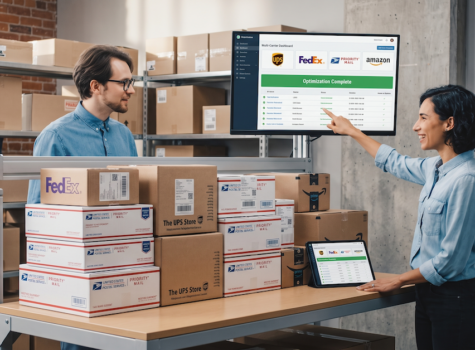

More than half of retailers now ship with carriers outside FedEx, UPS, and USPS. The recent FreightWaves piece does a really good job explaining how we got here. I loved it, and I want to build on it, because there’s a second layer under the story that most of the commentary this week skated right past. It changes what you should actually do about it.
Start with the force the piece leads on: the clock. Consumers now expect free delivery in 2.6 days, down from the 3.4 that held for years (AlixPartners 2026 Home Delivery Survey). Being able to do that on the old three-carrier setup simply stopped being possible. The second force FreightWaves noted is huge. FedEx and UPS are deliberately walking away from home delivery to chase B2B. Put those together and retailers were really left without any other option but diversification.
Here’s what I’d add, especially if you’re sitting in that 55%. Adding carriers is the easy part. Turning one on is close to instant now. The hard part starts the morning after you’re running eight of them. A pile of carriers you can’t switch between in real time isn’t resilience. It’s a bigger mess with a better name, and almost nobody is ready for it.
Diversification didn’t solve the problem. It moved it.
For two decades, the shipping question was a procurement question: which carrier gives me the best rate for this lane? You negotiated once a year, locked in your contracts, and lived with them.
Diversification breaks that model in a good way and a hard way at the same time. The good way is obvious. More than 90% of executives now run a mix of carriers, and 32% use four or more. That’s real leverage and real resilience.
Source: AlixPartners 2026 Home Delivery Survey
It’s the hard part that we sometimes ignore. The moment you’re running four to 12 carriers, the question stops being which carrier did I sign and becomes which carrier should handle this specific package, right now, given this destination, this weight, this deadline, and how that carrier is actually performing this week. That’s not a procurement decision. You make it thousands of times a day, at the moment a label gets generated, whether you’re paying attention or not.
Most teams aren’t paying attention, and I understand why. They diversified the carrier list and kept making selection decisions the old way, with static rules written once and left alone. The label prints either way, nothing catches fire, and the cost of leaving it on autopilot doesn’t surface until later. So they’re carrying the complexity of a dozen carriers and getting a fraction of the upside.
The cheapest carrier isn’t the right one anymore
The most underrated line in the FreightWaves piece isn’t the 55%. It’s that reliability has edged past cost as the top reason executives pick their primary last-mile carrier. After 20 years of optimizing for cost per package, the criterion flipped. That’s the kind of line I don’t take at face value, so I poked at it a little. Reliability didn’t really replace cost. Unreliability was always a cost. It just showed up later, on the customer-churn line instead of the rate line, which is why it took a survey to make it visible.
Here’s why that flip matters. When cost was the goal, a static carrier rule was fine. Cheapest carrier for the zone, set it and forget it. But reliability isn’t a number you lock in a contract. It moves. A carrier that’s hitting its windows in March starts slipping in November when volume spikes. A regional carrier that’s excellent in the Southeast is a liability in the Mountain West.
If reliability is now the thing you’re optimizing for, a rule you wrote in January is already wrong by peak. And the cost of being wrong isn’t a line on an invoice anymore. It’s the customer. Eighty-eight percent of shoppers said a late delivery with nothing but an apology weakens or ends their willingness to buy from that retailer again. That’s roughly a fifth of demand riding on whether your carrier selection logic reflects reality or reflects last year.
Choosing between them is a technology problem
FreightWaves put its finger on the real problem here. Running four to 12 carriers is a technology problem more than a procurement one.
The example they use is Maersk. One label, two barcodes. One for tracking, one identifying the assigned carrier. When a carrier stumbles, the system reassigns the package and the shipper does nothing. The quote from their ecommerce lead is the whole thing in a sentence:
“You as the customer, you know what you have to do? Nothing. I do it.”
That’s the capability everyone actually needs. Not more carriers. A layer that decides between the carriers you already have, at the moment of shipment, and reroutes when something breaks.
And this is where the article draws a line most mid-market operators are going to find themselves on the wrong side of. Maersk built that in-house because Maersk has Maersk’s balance sheet. The piece is honest about it: most shippers don’t, which is exactly why a whole market has grown up around making that choice for you. The question for everyone who isn’t a global logistics conglomerate is simple. If you can’t build that decision-making into your own systems, where does it come from?
You don’t need Maersk’s balance sheet
This is the problem EasyPost has been built around from the start, and the specific part matters. The multi-carrier access is table stakes. One integration, 100+ carriers, so you’re not stitching together a dozen APIs by hand. But most platforms stop there, selling you the carrier list as if the list was the hard part. It never was.
The point is the decision layer on top of it, and what makes that layer work is speed. The carrier decision runs the instant a label is created, on every package, automatically. Rate shopping and carrier selection happen in real time against current rates and current performance, not against a rule someone wrote nine months ago. No queue, no analyst pulling a report, no one manually rerouting anything. By the time a person could open a spreadsheet to compare carriers, the label is already printed on the right one. That’s the difference between owning 12 carriers and actually using them.
That’s also the honest version of the Maersk story for a company without Maersk’s balance sheet. The difference is timing. The switch happens before the label prints, not after a carrier stumbles and someone scrambles to react. You don’t need to build that yourself. You need to plug into something that already does it. The gap the FreightWaves piece describes, where enterprises can build this and everyone else is stuck, is precisely the gap a platform is supposed to close.
Obviously, EasyPost can’t run your dock or pack your boxes. But what EasyPost does is make the thousands of small carrier decisions underneath your operation deliberate instead of a rule nobody has revisited since last year. In a market where reliability is now the whole game and a late package costs you the customer, that’s not a nice-to-have. It’s the difference between diversification that pays off and diversification that just adds overhead.
The takeaway
If you diversified your carriers over the last two years, you did the right thing. But adding carriers was the easy part, and it’s mostly behind you now. The teams that win the next two years aren’t the ones with the longest carrier list. They’re the ones who fixed how the selection decision actually gets made, running it automatically and at scale against conditions as they are today, not as they were when the contract got signed.
Carrier diversification unraveled the duopoly. How well you choose between your carriers decides who comes out ahead.
If you’re running more carriers than you can actually choose between, that’s the gap EasyPost was built to close. It runs on a layer of AI that makes that call for you, on every shipment. Worth a look before peak.
Turn your carrier list into carrier decisions
Start with one integration to 100+ carriers and the industry’s most trusted shipping APIs. Then let a layer of AI pick the right carrier for every shipment, so you save money, ship faster, and deliver the reliable experience that keeps customers coming back.
“`