

Most rate comparisons start the same way. Someone pulls up USPS, UPS, and FedEx published rates, lines them up in a spreadsheet by weight, picks the lowest number in each row, and calls it a decision. It feels rigorous. It’s also how a lot of shippers end up overpaying without ever seeing it.
The problem isn’t the carriers. It’s the unit of comparison. A base rate is the price before the charges that determine what you pay: residential fees, fuel, dimensional weight, and your own negotiated discounts. Compare on the base number and you’re comparing the wrong thing, confidently.
This piece walks through how to compare carriers so the comparison holds up: a five-step process you can run, what to include at each step, why the cheapest carrier changes package to package, and the adjacent questions a simple rate table never answers.
Which carrier is actually cheapest
For a quick answer: USPS is usually the cheapest shipping option for lightweight parcels, UPS and FedEx get more competitive as weight and size go up, and FedEx and UPS win on guaranteed express transit. That’s the pattern behind almost every “USPS vs UPS vs FedEx” comparison of shipping rates by weight.
Here’s the rough shape of it in 2026, before surcharges:
| Shipment profile | Typically cheapest | Why |
|---|---|---|
| Under 1 lb, residential | USPS Ground Advantage | Low base rate, free residential delivery |
| 1–5 lb, regional | USPS or UPS Ground | Close race; zone and box size decide it |
| 6–20 lb | UPS / FedEx Ground | Ground pricing pulls ahead of Priority |
| 65+ lb | UPS / FedEx Ground | Nearly tied in 2026 |
| Guaranteed 1–2 day | FedEx / UPS Express | Speed and service guarantees |
It’s a fine starting point, but look at what the table can’t tell you: which carrier is cheapest for your box, to your customer’s ZIP, after your discounts. That’s the number that hits your invoice, and it rarely matches the base-rate winner.
Why the cheapest base rate isn’t the cheapest shipment
Once you load the charges that ride on top of the base rate, the ranking moves. Sometimes it flips completely.
Residential surcharges are the clearest example. In 2026, UPS and FedEx each add roughly $6.45 to $6.50 per residential ground package, and more for air and express, while USPS includes residential delivery at no extra charge. For a DTC brand shipping almost entirely to homes, that single line can erase a base-rate advantage on every order you send.
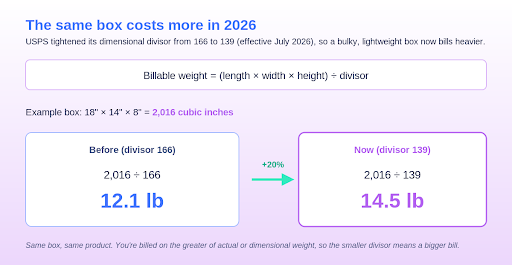
Dimensional weight is where more of the hidden cost lives. Carriers bill on the greater of actual weight or dimensional weight, and dimensional weight comes from box size, so a light product in an oversized box gets billed as if it were heavy. This got more expensive in 2026: USPS tightened its dimensional divisor from 166 to 139 for packages over one cubic foot, effective in July. A smaller divisor produces a larger billable weight for the same box.
Dimensional weight, worked out
- Formula: (length × width × height) ÷ divisor = billable weight.
- An 18″ × 14″ × 8″ box is 2,016 cubic inches.
- Old USPS divisor: 2,016 ÷ 166 = 12.1 lb billable.
- New USPS divisor (July 2026): 2,016 ÷ 139 = 14.5 lb billable.
- Same box, same product, ~20% more billable weight than a few months ago.
Fuel surcharges, address corrections, and delivery-area surcharges (DAS) stack on from there. The result is a well-documented trap: comparing one carrier’s base rate against another’s fully-loaded cost is an apples-to-oranges comparison, and it runs one direction. Analyses of parcel spend have found shippers making it overpay by around 6% on average. On a $10 million annual parcel budget, that’s roughly $600,000.
How to compare shipping rates in five steps
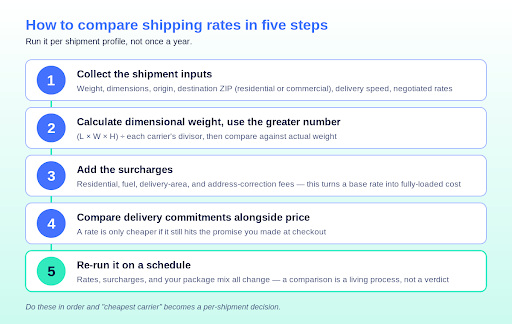
Here’s the process the base-rate spreadsheet skips. Run it per shipment profile, not once a year.
- Collect the shipment inputs. Actual weight, box dimensions, origin, destination ZIP (and whether it’s residential or commercial), required delivery speed, and your negotiated rates for each carrier.
- Calculate dimensional weight and use the greater number. Run (L × W × H) ÷ each carrier’s divisor, then compare against actual weight. Carriers bill the larger of the two.
- Add the surcharges. Residential, fuel, DAS, and address-correction fees. This is the step that turns a base rate into a fully-loaded cost, and the step most comparisons drop.
- Compare delivery commitments alongside price. A rate is only cheaper if it still hits the promise you made at checkout. Line up transit time and service guarantees next to the loaded cost.
- Re-run it on a schedule. Rates, surcharges, and your package mix all change. A comparison is a living process, not a one-time verdict.
Do these five in order and the “cheapest carrier” stops being a fixed answer and becomes a per-shipment decision.
The comparison that actually matters
The right unit is fully-loaded cost per shipment: the real, all-in price to move this package to this destination, compared across every carrier you can use, at the moment you buy the label.
Here’s what that looks like on a single order, a 3 lb apparel item in an oversized poly mailer going to a home address:
| Cost component | USPS Ground Advantage | UPS Ground | FedEx Ground |
|---|---|---|---|
| Base rate (illustrative) | slightly higher | slightly lower | comparable |
| Residential surcharge | $0 | ~$6.50 | ~$6.45 |
| DIM penalty (bulky mailer) | minimal | applies | applies |
| Fully-loaded cost | lowest | higher | higher |
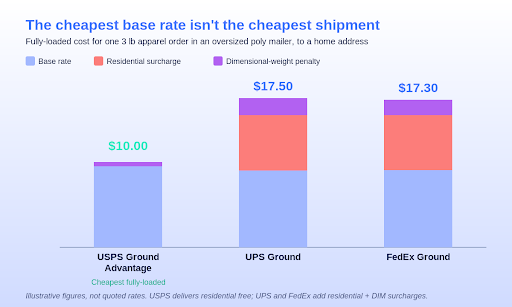
On the base-rate line, UPS looks like the winner. Load the real charges and it inverts, because the residential fee and the dimensional penalty land on UPS and not on USPS. The “more expensive” carrier on paper is the cheaper shipment in reality. Multiply that inversion across a few thousand daily orders and it stops being a rounding error.
The questions a rate table skips
“Which carrier is cheapest” is the easy question. The searchers who control shipping budgets are asking harder ones, and a comparison that ignores them isn’t complete.
How do negotiated rates change the comparison? They can flip it entirely. If you ship more than a few hundred packages a month, you likely have negotiated discounts, and a brand locked into a deep UPS or FedEx agreement sometimes finds the multi-carrier “savings” disappear because the negotiated rate already beats the alternatives. That’s fine; the point of comparing is to know, not assume. Any real comparison has to run on your contracted rates, not published ones.
Should I compare transit times as well as cost? Yes. The cheapest option that arrives late isn’t cheap; it’s a WISMO ticket and a refund. Weigh delivery commitment against loaded cost, and treat a blown delivery promise as a cost line of its own.
Regional carriers or the nationals? Regional carriers (think OnTrac, or a zone-specific parcel carrier) frequently beat the nationals on cost and transit within their footprint. They add integration overhead, but for high-volume lanes they’re often the cheapest shipping option no national can match. Leaving them out of the comparison caps your savings before you start.
Flat rate or calculated? Flat-rate packaging can beat calculated rates for heavy items in small boxes, and lose badly for light items in large ones. It’s another variable in the comparison, not a shortcut around it.
What about international? International adds duties, taxes, and customs documentation to the comparison, and carrier strengths shift by destination country. The same fully-loaded logic applies, with more line items.
How much volume do I need before this matters? The rough threshold is around 100 shipments a month or $1,000 in monthly spend. Below that, the time cost of comparison outweighs the savings. Above it, the savings compound fast, and by a few hundred orders a day the difference between comparing and not comparing is a full-time salary’s worth of margin.
How often should I re-evaluate? At least quarterly, and immediately after any carrier general rate increase. Your package mix and zone profile drift throughout the year; the routing rules don’t update themselves.
Where each way of comparing breaks down
There are really only a handful of ways to run this comparison, and each one holds up to a point.
A spreadsheet is where most teams start. It’s flexible and free, and it works fine for a monthly strategic review of a few shipment profiles. It falls apart the moment you try to apply it per order at volume. Nobody is hand-calculating fully-loaded rates for 8,000 daily shipments.
Carrier portals and shipping calculators give you accurate rates for one carrier at a time, which is the catch. Comparing means logging into three or four portals and reconciling them by hand, and none of them will tell you a competitor is cheaper.
A TMS or shipping software with built-in rate shopping automates the lookup, which is a real step up. The quality depends entirely on whether it returns fully-loaded rates and whether anyone keeps the routing rules current. Having the carriers connected doesn’t mean you’re routing across them. A setup configured last year is still pricing against a rate table that’s gone.
A shipping API pulls live shipping rates from every carrier programmatically and routes each label automatically. It’s the only approach that runs the full five-step comparison on every shipment without a person in the loop, which is what the broader case for multi-carrier at scale ultimately depends on. For the other places shipping spend leaks, our guide to reducing shipping costs covers the recurring culprits.
Every one of these works up to a point, and the point is set by your volume and how often carrier rates move. Most teams outgrow the spreadsheet long before they admit it.
Automating fully-loaded comparison
Once you’re past the volume where manual comparison keeps up, the durable version is automated. A multi-carrier shipping API returns fully-loaded rates (surcharges and your negotiated discounts included) from every carrier at once, and routes each label to the cheapest option that still meets the delivery promise. Real-time rate comparison through Luma AI adds service performance and transit reliability to the decision, so “cheapest” doesn’t turn into “late.” Rates update automatically when carriers change them, so the January increases and the July dimensional change get absorbed without a fire drill.
Industry analyses put the savings from per-shipment rate shopping across three or more carriers at 15% to 25% of total shipping spend versus single-carrier shipping. EasyPost has seen it firsthand. A global recommerce marketplace shipping more than 25,000 labels a day used Luma AI Select to evaluate each shipment at label creation and pick the smartest service level from the carriers it already had. A 4–5% per-label reduction added up to more than $2 million a year, alongside roughly 273,000 fewer late deliveries. No new carriers, no renegotiated contracts, no added headcount. The savings came from comparing the right cost on every shipment, not from a new contract or a secret discount.
Frequently asked questions
Which shipping carrier is cheapest?
It depends on the shipment. USPS is usually cheapest for lightweight residential parcels, while UPS and FedEx get more competitive on heavier and larger packages. After surcharges and negotiated discounts, the cheapest carrier changes package to package, which is why per-shipment comparison beats picking one carrier.
How do I compare shipping rates across carriers?
Compare fully-loaded cost per shipment. For each order, factor in the base rate plus dimensional weight, residential fees, fuel, and your negotiated discounts, then compare that true cost across every carrier for the destination and service level you need.
What is carrier rate shopping?
Rate shopping is comparing carrier rates for a specific shipment and selecting the option that meets your delivery promise at the lowest cost. Run on every shipment with fully-loaded rates, it typically reduces total shipping spend by 15% to 25%.
What surcharges should I include when comparing rates?
At minimum: residential delivery surcharges, fuel surcharges, dimensional weight, delivery-area surcharges, and address-correction fees. Leaving these out is the most common reason a comparison points to the wrong carrier.
Do negotiated rates change which carrier is cheapest?
Yes. Negotiated discounts can be large enough to flip the comparison, and a deep single-carrier agreement sometimes beats multi-carrier rates outright. Always run the comparison on your contracted rates, not published ones.
Are regional carriers cheaper than national carriers?
Often, within their coverage area. Regional carriers frequently beat USPS, UPS, and FedEx on cost and transit for specific zones, at the cost of added integration. For high-volume lanes they’re worth including in the comparison.
How often should I compare carriers?
At least quarterly, and right after any general rate increase. Package mix, zones, and carrier pricing all shift during the year, so a one-time comparison goes stale quickly.
The takeaway
Comparing carriers is the right instinct. Comparing base rates is where it goes wrong, because the charges you leave out are exactly the ones that move the ranking.
Compare fully-loaded cost, per shipment, and keep comparing as rates change. At volume, that’s what separates the shipping budget you planned from the one you’re quietly overrunning.