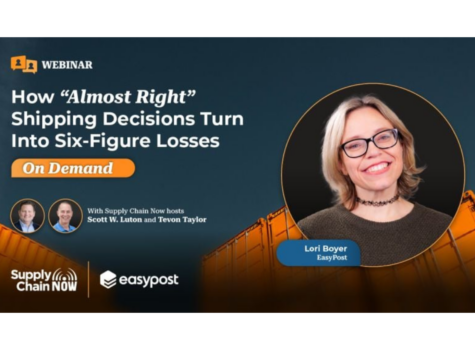

A shipping operation can look healthy on the surface while quietly bleeding money.
That was the focus of a recent webinar hosted by Scott Luton and Tevon Taylor from Supply Chain Now, featuring Lori Boyer, host of Unboxing Logistics. Drawing from billions of shipment data points across ecommerce, retail, and 3PL operations, Lori walked through the patterns EasyPost has seen across modern fulfillment networks.
She began by observing, “Most people are trying to do the right things… They’ve negotiated their rates, added carriers, invested in systems, and built their logic, and they’re still having problems.”
Sound familiar? If so, keep reading!
This article recaps key ideas from the webinar, highlighting the almost right shipping choices that might be hurting your business and sharing practical strategies for turning things around.
Key takeaways
- Many businesses lose money through small, repeated shipping decisions that seem reasonable individually but become expensive at scale.
- A true multi-carrier strategy requires actively testing and optimizing carriers by lane, not simply having multiple carrier contracts.
- Companies often overpay for expedited shipping even when ground delivery would meet customer expectations just as effectively.
- Packaging inefficiencies like oversized boxes and poor cartonization continue to drive unnecessary DIM charges across high-volume operations.
- Real-time, AI-driven shipping optimization is helping fulfillment teams reduce costs and late deliveries without adding more manual work.
Almost right carrier strategies
Many companies believe they have a multi-carrier strategy because they use multiple carriers. But that’s not always true.
Lori described situations where businesses technically worked with four or five providers, yet 80% of shipments still flowed through a single carrier.
That difference matters because carrier performance has become increasingly lane-specific. One provider might dominate in a particular region while another performs better just a few states away. And if you’re not keyed into those distinctions, you’re probably not shipping as efficiently as possible.
For example, Lori pointed to regional carriers like:
- OnTrac in coastal metro areas
- SpeedX in parts of the Midwest
- LSO throughout Texas and the South
These carriers’ networks tend to be tighter and more concentrated, with fewer handoffs and fewer sortation points (translating to lower costs and faster deliveries).
Tevon summed things up well: “Different carriers win in different zones, weights, and delivery commitments.”
The takeaway isn’t that you should stop using national carriers—far from it. The issue is relying on broad assumptions. To build a true multi-carrier strategy, you’ll need to carefully review carrier performance for each type of package you’re shipping and each location you’re shipping to. Then, use technology to automate and optimize carrier selection.
A practical place to start
You don’t need a complete network overhaul to improve carrier decisions.
Start smaller:
- Review your top shipping lanes
- Compare ground versus expedited transit times
- Test regional carriers with a controlled portion of volume
- Revisit assumptions your team treats as “standard”
Lori also stressed the importance of actually using backup carriers instead of simply keeping contracts on file, since a backup strategy only works if it’s ready to go when volumes spike or disruptions hit.
Almost right service levels
It might be the most common cost leak in parcel logistics right now: paying for super fast shipping when you don’t actually need it.
Teams often default to two-day or overnight delivery because nobody wants late shipments or customer complaints. Over time, those exceptions become standard operating procedure.
Lori sees it constantly.
“People get really scared that they’re going to have a late delivery… and so maybe they’re overpaying for the service.”
But in many cases, the customer never expected premium shipping in the first place.
Use expedited shipping sparingly
One of Lori’s recommendations was to audit shipments where businesses pay for expedited services even though ground delivery would’ve arrived nearly as fast.
She shared that one retailer reviewed residential shipments in close regional zones and discovered that roughly 98% could have arrived via ground without significantly changing the customer experience.
That kind of analysis tends to uncover expensive habits:
- Overnight shipping on low-cost items
- Two-day shipping in dense regional lanes
- Expedited services attached to routine replenishment orders
Bottom line? While fast delivery still matters in certain scenarios, predictability often matters more. As Lori put it, “If you promised [a package] would come on Friday, customers care more that it comes on Friday than that it comes in two days.”
That’s a crucial distinction if you’re trying to balance shipping costs against customer satisfaction.
Match the shipment to the situation
Not every order deserves the same service level.
For example, while a first-time customer buying a high-value product might justify faster delivery, a subscription reorder probably doesn’t.
Price and use case both matter too; lower-cost, consumable products often have a different urgency than expensive luxury purchases.
Tevon left listeners with a simple rule of thumb: “Match the promise to the customer’s expectation.”
Almost right packaging decisions
Packaging conversations usually start with branding and procurement. Shipping costs enter later, often after the packaging standards are already locked in. But that can create major friction between departments.
Marketing wants presentation, operations wants efficiency, procurement wants lower material costs, and logistics wants lower transportation spend. Eventually, companies settle into “good enough” packaging decisions that stay untouched for years.
Meanwhile, dimensional weight pricing keeps getting stricter. “An inch of difference can completely throw you into a different category,” Lori explained.
This means that for high-volume operations, tiny packaging mismatches become expensive very quickly.
Where the costs usually hide
The biggest packaging issues tend to be surprisingly ordinary:
- Oversized cartons
- Excess void fill
- Too many box SKUs
- Lightweight products shipped in too-large boxes
- Default box selections that were never revisited
Tevon pointed out that many warehouse systems already have the data needed to improve cartonization logic automatically—it’s all about using the tools to their fullest capabilities. Although it doesn’t feel glamorous, packaging optimization can produce meaningful savings without changing the customer experience at all.
Almost right routing rules
Because routing logic ages faster than most companies expect, a rule that made perfect sense 18 months ago could be creating unnecessary costs today.
Think about it: carrier performance changes, surcharges shift, and weather disruptions reroute networks. With the world changing every time you blink, routing rules need to keep up.
Lori suggested reviewing routing logic quarterly at a minimum.
If you review less frequently, you could easily run into problems that are difficult to spot as the shipping environment continuously changes.
Almost right manual processes
At a certain shipment volume, manual shipping decisions stop being practical.
There are simply too many variables:
- Carrier performance
- Delivery commitments
- Weather disruptions
- DIM thresholds
- Surcharges
- Customer expectations
- Lane-specific transit times
Human teams can’t realistically evaluate all of that in real time across every shipment, and that’s where AI-driven shipping optimization is starting to make a measurable impact.
Lori shared that EasyPost has seen the benefits of AI for the shippers it works with.
She explained, “There are millions of dollars that can be saved simply by shifting service levels, by shifting routes, by adding in certain carriers. And that is happening all the time. AI has finally given us the ability to be able to make those decisions in real time in a way that we can trust.”
Automating repetitive decisions
Modern shipping AI tools can evaluate routing and service-level decisions at the label level using current shipment data, carrier performance trends, and business priorities.
With the repetitive micro-decisions out of the way, teams get more time back to focus on carrier negotiations, packaging strategy, exception handling, and other mission-critical tasks.
For instance, one shipper highlighted during the webinar reduced late deliveries by 750 packages per day and lowered shipping costs by roughly 5% per label, simply by improving routing and service-level decisions.
Shipping decisions that actually scale
Many fulfillment teams are still operating on shipping assumptions built for a simpler environment.
But like it or not, that environment is gone.
The encouraging part is that many of these problems are fixable without rebuilding your operation from scratch. And step one is getting visibility. Once you can see where the almost right decisions are happening, the fixes become much easier to prioritize.
To hear the full discussion, including Lori’s examples and Tevon’s operational perspective, watch the webinar on demand.
Improve shipping decisions without adding more complexity
EasyPost helps ecommerce businesses simplify shipping operations, automate smarter routing decisions, and uncover unnecessary shipping costs. It’s the future of shipping, made simple.