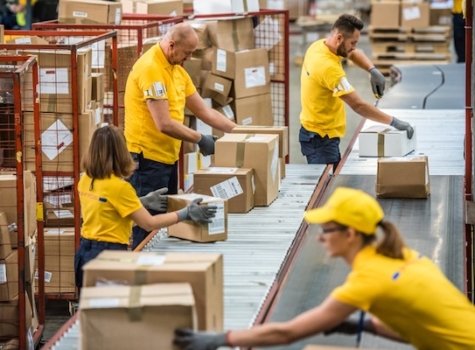

For ecommerce businesses managing fulfillment in-house, disruption has become part of daily operations.
But the challenge isn’t just the disruptions themselves.
It’s how quickly small problems can snowball into operational headaches that impact customers, costs, and team bandwidth.
This year during NPF, EasyPost hosted a live session featuring Unboxing Logistics host Lori Boyer. She discussed what “shipping chaos” actually looks like and how businesses can build more resilient fulfillment operations without overcomplicating things.
In this article, we’ve summarized the session’s real-life stories, key insights, and actionable strategies.
Why disruption feels constant in ecommerce shipping
Supply chains have always dealt with uncertainty. Weather delays, labor shortages, and fluctuating demand are nothing new.
According to Lori, the real shift over the last several years has been the growing number of smaller disruptions happening simultaneously. “We’re seeing a distinctive rise in additional layers of chaos that are more related to AI, to technology, to the massive influx of ecommerce.”
Unlike large-scale disruptions that dominate headlines, many of today’s problems happen behind the scenes. Things like …
- A vendor suddenly shutting down
- A carrier reaching capacity limits
- A social media trend creating a sudden order spike
These issues might not sound dramatic individually, but together they can create real problems for ecommerce teams.
The growing impact of micro-surges
Lori explained that micro-surges, or “unexpected, sudden [increases] in demand for a really specific thing,” have been catching many ecommerce brands unprepared.
She shared the example of a supplement company that typically shipped around 18,000 orders per day. After an influencer organically mentioned one product online, demand exploded almost overnight.
“By morning … like 50,000 orders had come in.”
Interestingly, inventory wasn’t the problem—the business actually had enough product available. The real issue was shipping capacity. The company’s carrier setup just couldn’t handle the sudden spike in label generation and outbound volume.
That distinction matters! Operational flexibility isn’t just about inventory planning. Your carrier setup and fulfillment workflows need to scale alongside demand as well.
What separates resilient operations from reactive ones
Throughout the session, Lori repeatedly returned to one core idea: preparation matters more than prediction.
While many companies spend time discussing possible disruptions, far fewer actually test what they would do if those disruptions happened tomorrow.
“One of the biggest assumptions people have is that if you plan, you’re good,” Lori explained. But in reality, planning is only one piece of the puzzle. You need to “have a plan and make sure that you’ve tested it.”
Questions worth asking before problems happen
For mid-size ecommerce businesses, resilience doesn’t necessarily require enterprise-level systems. Often, it starts with simple operational planning.
You might begin by asking these four questions:
- What is a disruption your operation will likely face?
- Which vendors or carriers represent the biggest risk?
- Who makes final decisions during disruptions?
- Have backup systems actually been tested?
Even lightweight planning can significantly reduce stress when things actually go wrong.
What a flexible supply chain actually looks like
When the discussion shifted toward flexibility, Lori emphasized that having options matters, and flexibility can come from several areas.
Carrier flexibility
Lori strongly recommended testing alternative carriers before disruptions force emergency changes.
“I recommend that you start with about 10% of volume and test run other carriers during a normal timeframe,” she advised.
This has several advantages:
- You understand carrier performance ahead of time.
- Teams become familiar with alternate workflows.
- You can compare costs across carriers.
- Capacity issues become easier to manage during spikes.
Regional carriers can also provide advantages in specific zones or delivery scenarios, especially when national networks become congested.
Vendor flexibility
The session included an audience example involving a vendor acquisition that eventually led to the supplier shutting down during peak season.
That experience reinforced three important lessons:
- Monitor vendor stability regularly.
- Watch for warning signs across payment or billing changes.
- Build backup supplier relationships early.
Lori also noted that businesses increasingly need visibility several layers deeper into their supply chains, not just direct vendor relationships.
Operational flexibility
Some flexibility is less about external partners and more about internal decision-making.
The companies handling disruption best often have:
- Regular operational review meetings
- Clear escalation processes
- Defined trigger points
- Cross-functional communication plans
- Scenario planning sessions
Lori encouraged businesses to schedule recurring discussions around operational risks instead of only reacting during emergencies.
Where AI is actually helping shipping teams
The session also addressed the growing role of AI in logistics, with everyone agreeing that shipping optimization is one place where the technology already provides meaningful value.
Because shipping generates large amounts of operational data, AI tools can help businesses:
- Compare carrier rates
- Identify more efficient routes
- Evaluate transit performance
- Reduce unnecessary shipping costs
- Improve delivery speed decisions
Lori shared one example where shipping data revealed that certain “three-to-five-day” services still arrived in two days most of the time. That kind of visibility can help businesses reduce costs without negatively affecting customer experience.
Three practical steps to prepare for disruption
Near the end of the session, Lori outlined a simple framework that teams can apply immediately.
1. Identify your most likely disruption
Start by identifying the operational issue most likely to affect your business.
That could include:
- Carrier capacity issues
- Labor shortages
- Vendor instability
- Unexpected demand spikes
- Rising shipping costs
2. Build a response plan
Document what actions your team would take if that disruption occurs. This step includes identifying key decision-makers, choosing backup vendors or carriers, and outlining workflow adjustments.
You’ll also want to make a customer communication plan so nobody is left out of the loop if their package fails to arrive on time.
3. Define a trigger point
Finally, Lori recommended “defining a trigger now so that when it happens, your plan goes into place.”
Examples might include:
- Order volume exceeding a certain threshold
- Delivery delays crossing a target percentage
- Carrier capacity reaching a specific limit
- Inventory levels dropping below a benchmark
Triggers remove uncertainty during stressful moments. When teams already know what action to take, they can move faster and avoid unnecessary confusion.
Small improvements create calmer operations
One of the strongest themes throughout the session was that resilience doesn’t always come from massive transformation projects. Instead, it often stems from smaller operational habits that improve consistency over time.
The main takeaway: focus on simple changes rather than trying to overhaul everything at once. That might mean testing backup carriers, reviewing vendor relationships quarterly, or exploring new optimization tools.
None of these changes are flashy. But over time, small improvements make fulfillment operations significantly more adaptable when disruption inevitably appears.
Build more flexible shipping operations with EasyPost
EasyPost helps businesses simplify multi-carrier shipping, compare rates, improve delivery decisions, and create more resilient fulfillment operations. Sign up for free to get started!